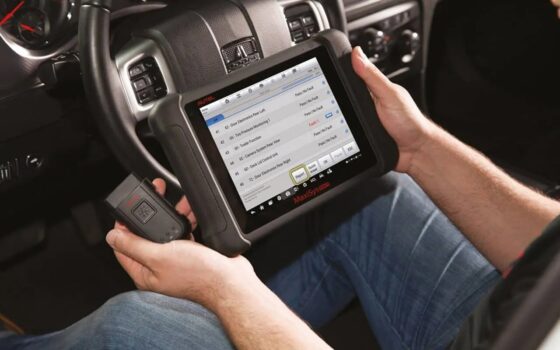
Car scanners are essential tools for diagnosing vehicle issues, empowering DIY mechanics and professionals to identify and resolve problems efficiently. These devices connect to a car’s OBD-II port, typically located under the dashboard, to read diagnostic trouble codes (DTCs), monitor live data, and reset service lights like oil or TPMS. Ranging from compact Bluetooth dongles to advanced wired tablets, they support vehicles post-1996 with protocols like CAN-Bus, ISO 15765, and SAE J1850. Features include full-system diagnostics (engine, ABS, SRS, transmission), bi-directional controls, and performance testing, with some offering lifetime updates for ongoing compatibility.
Car scanners are essential tools for diagnosing vehicle issues, empowering DIY mechanics and professionals to identify and resolve problems efficiently. These devices connect to a car’s OBD-II port, typically located under the dashboard, to read diagnostic trouble codes (DTCs), monitor live data, and reset service lights like oil or TPMS. Ranging from compact Bluetooth dongles…
Deep diagnostics for engine transmission ABS and SRS systems help ensure vehicle safety by resetting codes. Seven professional reset services including oil and brake maintenance save owners significant time and high costs. Lifetime free WiFi updates allow users to keep diagnostic software current without paying any monthly subscriptions. Wide vehicle coverage supports ninety nine percent of global cars including latest FCA secure gateway access. Responsive five inch touchscreen and large internal memory provide a fast and very intuitive diagnostic experience.
Fast diagnostics with 5″ touchscreen, Android system, quad-core CPU, Bluetooth 4.0, Wi-Fi, Auto-VIN, and lifetime free updates. Supports 7 resets: oil reset, throttle adaptation, brake pad reset, ABS bleeding, gear learning, battery match, and steering angle calibration. Diagnoses 4 systems: engine, transmission, ABS, and SRS with real-time data, fault code reading/clearing, and OBD2 tests. AutoVIN reads vehicle info instantly for 100+ brands and 100,000+ models worldwide, no manual input needed. Shows 4-in-1 live data graphs and generates detailed PDF reports for easy tracking and sharing. ABS bleeding may require manual steps on some vehicles.
Offers 10 OBD2 functions including reading and erasing codes, I/M readiness, freeze frame, vehicle info, report printing, data stream, O₂ sensor test, on-board monitoring, and EVAP test. Quick I/M readiness test with one button delivers results in 5 seconds, making emission checks faster and easier. 2.8-inch HD screen provides 60% more viewing area and is readable in low light with high clarity for all users. Simple icon menu and 9-button layout allow fast, intuitive navigation without complex menus, ideal for beginners. Works with 99.9% of US (1996+), EU (2000+), and Asian (2008+) vehicles using OBDII/EOBD, with 5 language options. Does not support ABS, SRS, oil systems, diesel or hybrid vehicles; only reads engine-related data.
Features a new 2025 processor, Android 8.1, 32GB memory, 5-inch 720P touchscreen, 6100mAh battery, and one-touch Wi-Fi with lifetime free updates for expanded vehicle coverage. Adds 7 reset functions including Throttle Adaptation, Oil Reset, SAS Reset, ABS Bleeding, BMS Reset, EPB Reset, and DPF Regeneration for deeper car system diagnostics. Supports diagnostics for 4 major systems: Engine, Transmission, ABS, and SRS, with fast and precise trouble code reading and live data display. Displays live data on the 5-inch screen with playback feature to record parameters during driving, plus options to print and share diagnostic reports. Monitors battery voltage in real-time with graphs and text, and generates vehicle health reports that can be recorded, shared, and printed. May have limited compatibility with some vehicle models; always verify support before purchase to avoid inconvenience.
Designed specifically for BimmerCode and recommended by the BimmerCode Team (app sold separately). Provides 100% coverage of vehicles, protocols, and advanced features supported by BimmerCode. Easy in-app pairing with iOS and Android devices for quick setup and use. Features advanced sleep mode and overvoltage protection, allowing the device to be left plugged in safely. Offers a rock-solid connection that prevents data corruption, dropped packets, and avoids bricking your ECU. BimmerCode app is not included with the purchase and must be bought separately.
Performs OBD-II diagnostics to read and clear trouble codes, view freeze frame, O2 sensor data, live data, and I/M readiness for vehicle monitoring. Compatible with various OBD apps like Car Scanner ELM OBDII, Torque (Android), BimmerCode, BimmerLink, and others; apps or features may require separate purchase. Supports most 2001+ petrol and 2004+ diesel vehicles in the EU; check EV/PHEV compatibility with Car Scanner app or manufacturer before buying. Works with iOS via Bluetooth LE (in-app connection required) and Android via Classic Bluetooth; Android head units are not supported. Advanced diagnostics for ABS, SRS, TPMS, and manufacturer-specific data are available only on select vehicles through special apps. Does not support service resets, DPF regeneration, or compatibility with apps like ABRP (Android), Carly, MHD, xHP, ProTool, or bootmod3.
Features a built-in OBD2 DTC lookup library to read and erase engine codes, view freeze frame, I/M readiness, vehicle info, real-time data, and engine parameters. Supports 9 protocols compatible with most 1996+ US, 2000+ EU, and Asian vehicles, with 10 language options and a clear 2.8-inch TFT display. Powered directly from the vehicle’s OBDII port, no battery or charger needed. Provides professional-level diagnostics for home mechanics and technicians, reading and clearing engine codes and displaying vehicle info. Helps check emission status and smog test readiness with trip cycle procedures for state compliance. Does not support ABS, Airbag, SRS, or Oil Service Light systems; limited to OBDII engine diagnostics only.
Features a built-in OBD2 DTC lookup library to read and erase engine codes, view freeze frame, I/M readiness, vehicle info, real-time data, and engine parameters. Supports all OBDII protocols including KWP2000, J1850 VPW, ISO9141, J1850 PWM, and CAN, compatible with most 1996+ US, 2000+ EU, and Asian vehicles. No apps, WiFi, battery, or charger needed; plug and play with an extended 2.5-foot cable for easy access in tight spaces. Intuitive menu with 6 buttons for scrolling, selecting, and quick queries of VIN and DTC codes on a clear LCD screen with adjustable backlight. Compact and durable design with a thick flexible cable, suitable for DIY users and mechanics alike. Does not support ABS, Airbag, or Oil Service Light codes; limited to OBDII engine system diagnostics only.
Designed for Land Rover and Jaguar owners, offers 5 times faster diagnostics with 43 service functions and full OBD2 plus system coverage. Performs in-depth diagnosis on over 270 systems including engine, transmission, ABS, SRS, fuel, steering, airbag, lights, air conditioning, and more. Supports 43 service functions like Oil, SAS, EPB, BMS, DPF, TPMS, immobilizer, odometer, clutch, turbocharger, and oxygen sensor resets for quick repairs. Features powerful bi-directional control to communicate with vehicle modules, allowing real-time data reading and active testing of components like injectors, fans, windows, and more. Includes Auto VIN, one-key automatic diagnosis, lifetime software updates, and hardware repair support. Some vehicle models may not support bi-directional control due to protocol limitations; check compatibility before purchase.
Turns your phone or tablet into a car scan tool, reading check engine codes, freeze frame data, real-time sensor readings, I/M readiness, and fuel economy. Compatible with 2001+ petrol and 2004+ diesel vehicles in EU and UK for generic OBD II; advanced features supported only on selected vehicles with certain apps. Works with iOS (Bluetooth LE, connect via app) and Android (Bluetooth pairing); head units not recommended. Supports apps like Car Scanner, OBD Fusion, Torque, Infocar, BimmerCode (2008+), BimmerLink (2008+), Carista, and Dr. Prius; some apps may require purchase. Not compatible with BMW pre-2008 models and G series for BimmerCode; pre-2008 models unsupported by BimmerLink; hybrids and EVs need special apps. Does not support apps like Carly, MHD, xHP, and ProTool; check compatibility before use.
Works with most OBD2 vehicles from 1996 onward. Pairs with apps like Torque and Car Scanner. Supports code reading, I/M readiness, and O2 tests. Stable Bluetooth with fast connection. Doesn’t support advanced ECU coding features.
Covers 120+ vehicle brands. Offers real-time diagnostics and reports via app. Supports service resets like oil and EPB. Easy to pair and use with a phone. Some features require in-app purchase.
VDIAGTOOL VD30 Pro OBD2 Scanner, Car Diagnostic Tool
Scans engine, ABS, transmission, and more. Shows live data with graphing. Includes lifetime software updates. Has its own screen, no phone needed. Bulkier than compact Bluetooth models.
Vgate iCar Pro Bluetooth 4.0 (BLE) OBD2 Fault Code Reader
Works on both iOS and Android. Reads codes and logs real-time sensor data. Compatible with popular OBD apps. Auto-sleep mode saves battery life. Doesn’t support advanced diagnostics on all brands.
Advertising Disclosure: The expertpicks.hsvrap.site's users back the website. An affiliate commission may be paid to us if you purchase any of the items that are promoted on our website.